Industrial floors that keep your operation moving.
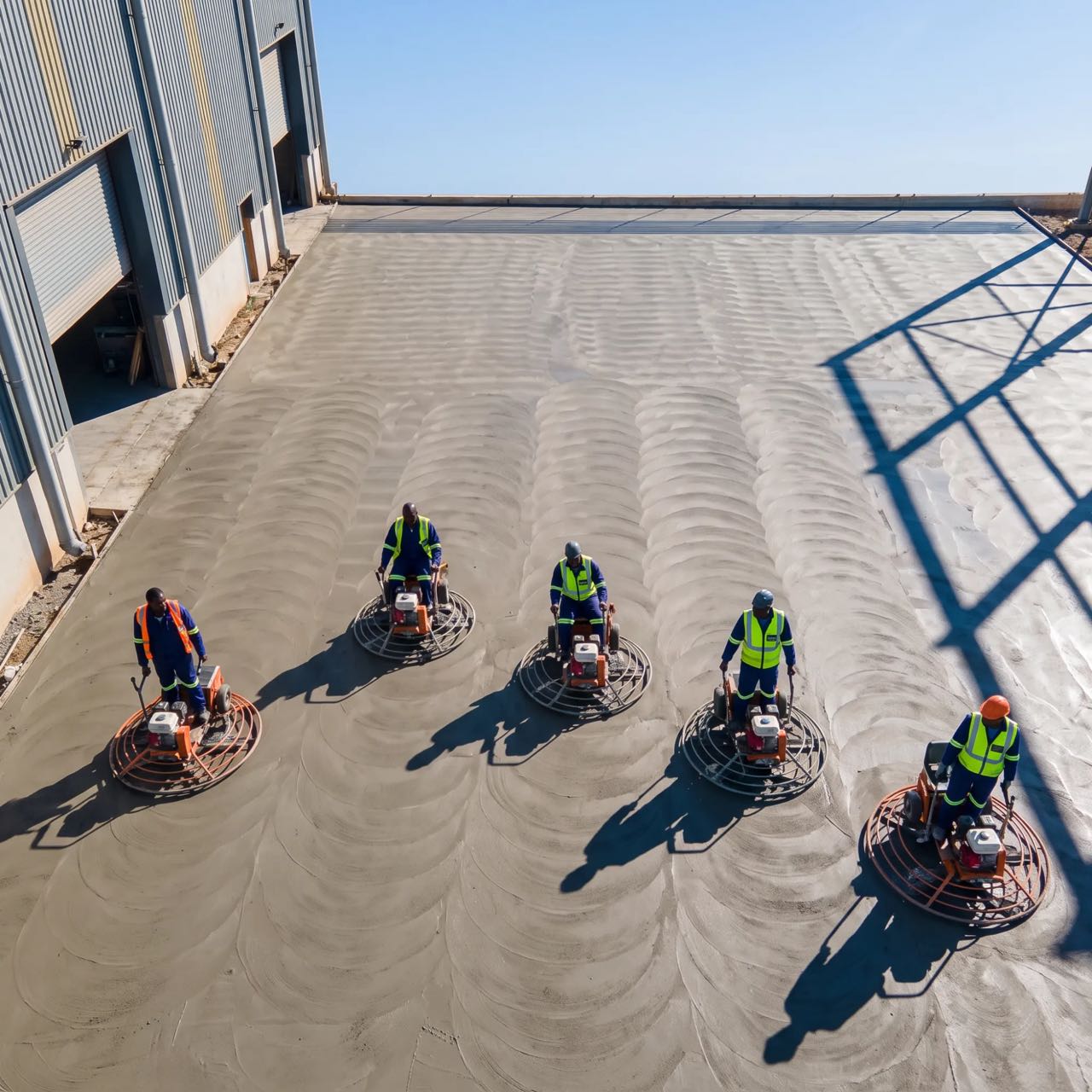
Forklifts, pallet racking, steel-wheeled trolleys and daily washing will find any weakness in a floor. We power float and harden industrial slabs so they stay flat, dense and dust-free for years.
years finishing floors since 2005
projects completed across Kenya
square metres of floor finished
WhatsApp reply time in working hours
A bad warehouse floor costs you every day
Dust on stock
A weak surface sheds dust onto goods, machines and products, and someone has to sweep it every day.
Broken joints
Forklift wheels break up joints that were badly cut or left unprotected, so the floor gets rougher every month.
Leaning racking
Floors that are not flat make tall racking lean, and they wear out forklift masts and tyres.
Repair downtime
Every repair means moving stock and stopping work. The cheapest floor at handover is rarely the cheapest over ten years.
What goes into a Renkelly floor
- Pre-pour check. We review the sub-base, concrete grade, slump and pour sequence with your engineer or contractor.
- Ride-on power trowels for large bays, so the finish is the same from wall to wall within the pour window.
- Dry-shake hardener, natural or coloured, for abrasion resistance where traffic is heavy.
- Joint cutting at the right time and spacing to control cracking.
- Curing from day one under a membrane or curing compound.
- Optional extras: sealing, epoxy, line marking and anti-slip zones.
Planned around your pour
Site check & set-out
We confirm levels, screed rails, access for the trucks and the pour sequence with your contractor. We also check the mix and slump.
Place & strike off
The concrete is placed, vibrated and struck off to level. Our crew and machines are already on site before the first truck arrives.
Float pass
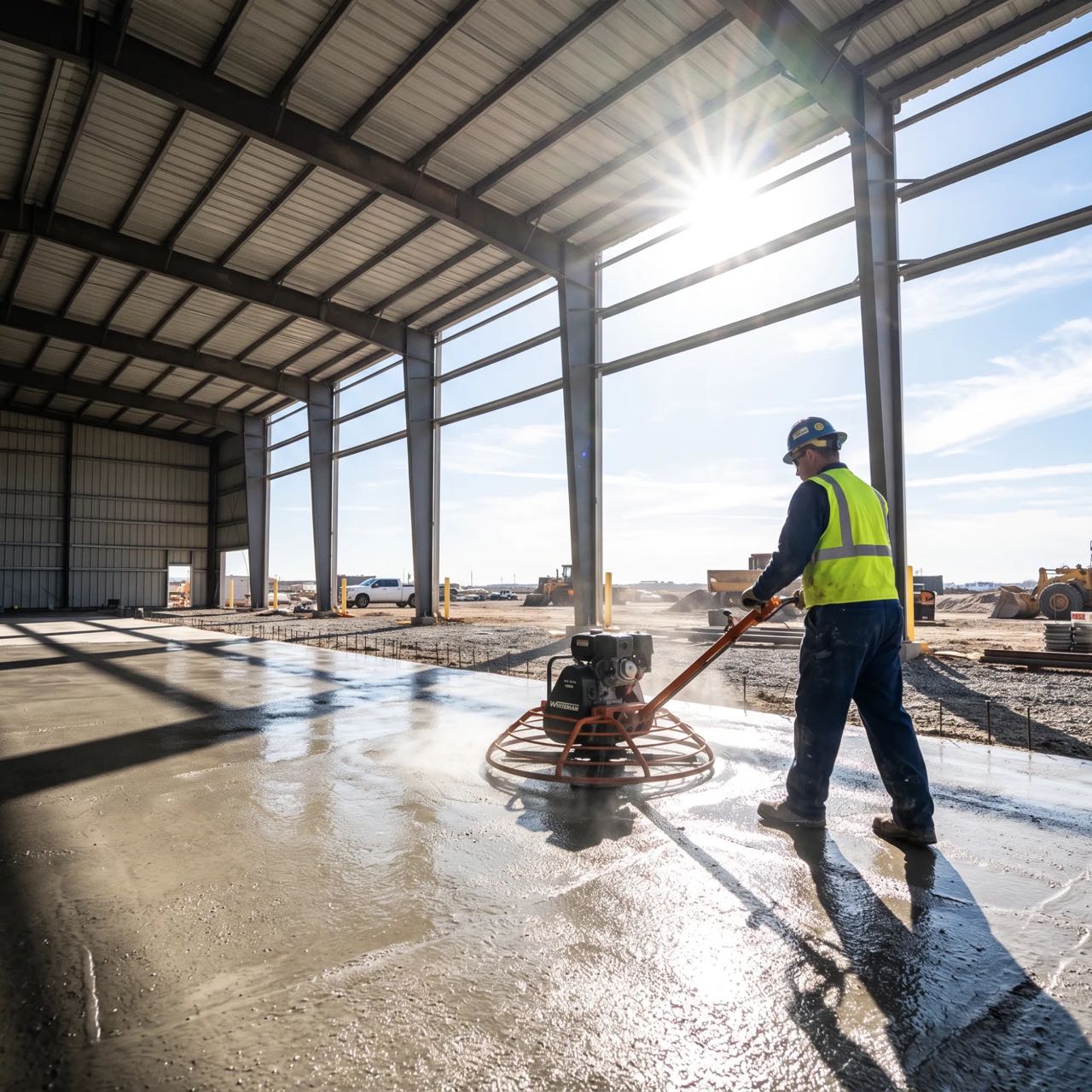
When a boot leaves only a 3 – 5mm print, the floats go on. Pans flatten the surface and bring up paste.
Hardener shake
Where specified, a dry-shake hardener is broadcast and floated into the surface so it becomes part of the slab.
Trowel passes
Blades come off the pans and the angle steepens with each pass, compacting and closing the surface to the finish you chose.
Cut joints & cure
Control joints are saw-cut at the right spacing and curing starts straight away, so the slab cracks where we want it to.
Hand over
Foot traffic after 2 – 3 days, light vehicles after 7, full racking and forklift loads at 28 days.
Times are typical and change with weather, mix and slab thickness. We finish to the concrete, not the clock.
Industrial floor questions
How long does a power-floated floor take to cure before use?
You can walk on it after 24 hours and allow light foot traffic within 2 – 3 days. Wait about 7 days before light vehicles and 28 days before heavy forklifts or full racking loads, so the concrete reaches its design strength. Keep the slab moist or under a curing compound for at least the first 7 days.
How do you prevent cracking?
We use a dry-shake hardener where traffic is heavy, cure the slab from day one, and saw-cut control joints within 24 hours at the right spacing so any cracking happens inside the joint. Good sub-base compaction, the correct concrete grade and no extra water in the mix matter just as much, and we check all of these before the pour.
What floor thickness do you recommend?
Usually 125mm (5 in) for homes, garages and light-duty floors, 150 – 200mm for warehouses and commercial floors, and up to 300mm (12 in) for heavy industrial loads. Your structural engineer sets the final figure, and we finish to whatever the design calls for.
What is the difference between power floating and an ordinary screed?
Power floating finishes the structural slab itself while it is still fresh, so the surface is part of the concrete. An ordinary screed is a separate layer laid later, which can crack, sound hollow or delaminate. A power-floated floor is flatter, denser and more durable. It usually costs less too, because there is no second layer.
Do you supply the concrete?
No. We are finishing specialists. You or your main contractor supplies the concrete, either ready-mix or batched on site. We advise on grade, slump and pour timing so the finish comes out right.
The power float cost guide
What drives the price per sqm, how to budget a warehouse or house slab, and 10 questions to ask any flooring contractor. We send it to your WhatsApp as a PDF.
Get an industrial floor quote
Tell us the area, location and what the floor will carry. A lead engineer replies within 30 minutes during working hours and books a free site visit.
- Starting from Ksh 250 per sqm
- A fixed written quote after a free site visit
- Our own ride-on & walk-behind machines and trained crew
- A workmanship warranty on every job
 Replies come from a lead engineer, not a call centre.